
Online Edition
Pages
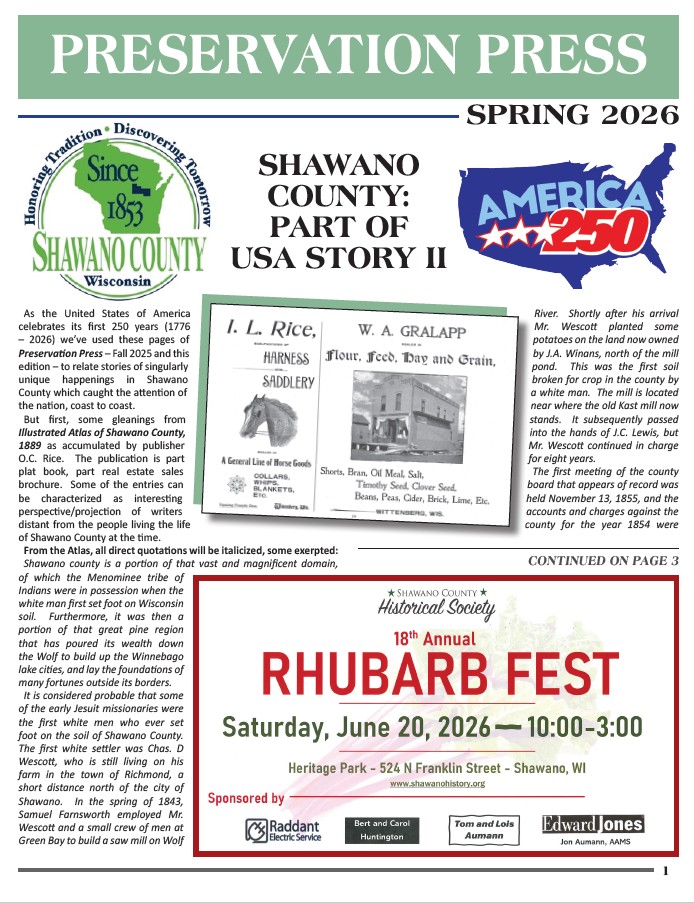
Preservation Press Spring 2026 page 1.
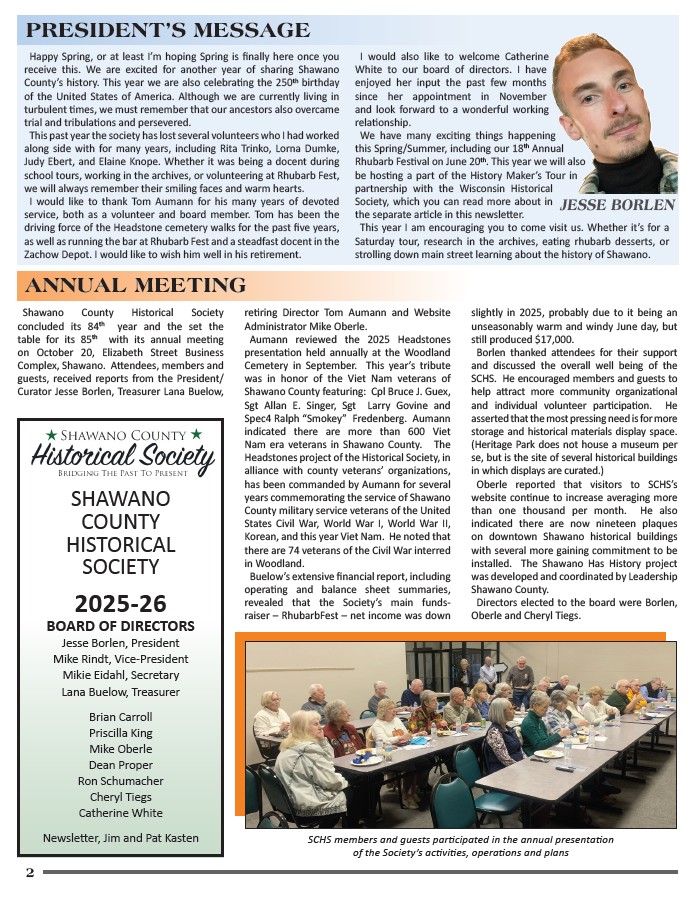
Preservation Press Spring 2026 page 2.
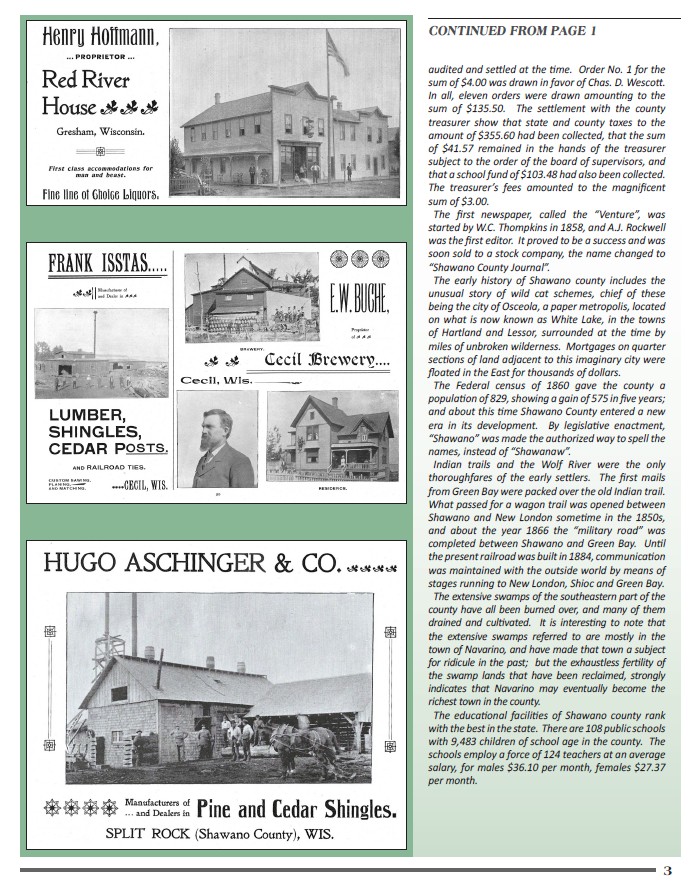
Preservation Press Spring 2026 page 3.
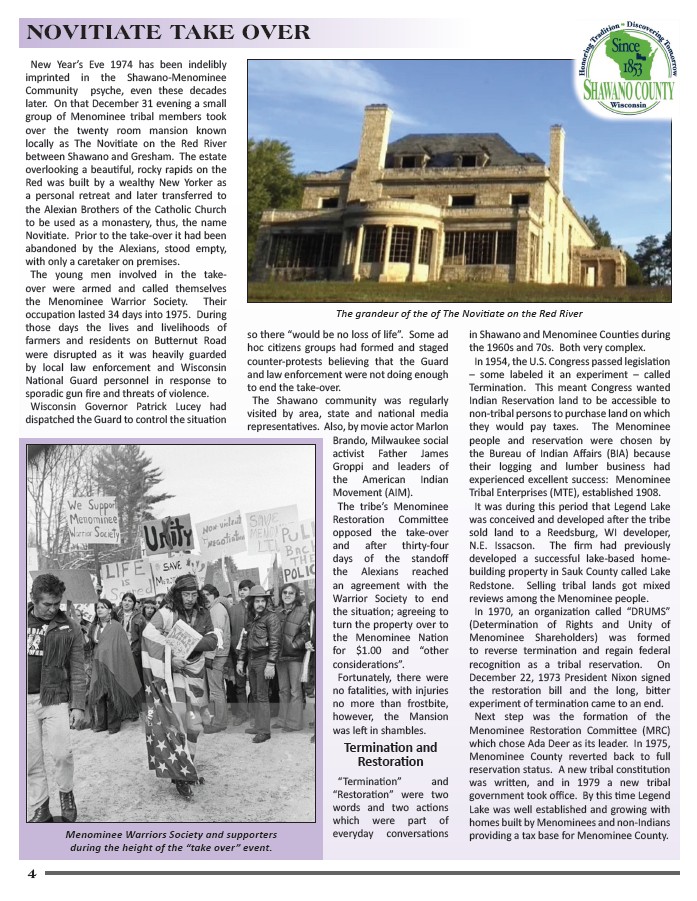
Preservation Press Spring 2026 page 4.
Preservation Press Spring 2026 page 5.
Preservation Press Spring 2026 page 6.
Preservation Press Spring 2026 page 7.
Preservation Press Spring 2026 page 8.
Preservation Press Spring 2026 page 11.
Preservation Press Spring 2026 page 10.

Preservation Press Spring 2026 page 11.
Preservation Press Spring 2026 page 12.
Preservation Press Spring 2026
Shawano County: Part of the USA Story II
As the United States of America celebrates its first 250 years (1776 – 2026) we’ve used these pages of Preservation Press – Fall 2025 and this edition – to relate stories of singularly unique happenings in Shawano County which caught the attention of the nation, coast to coast.
But first, some gleanings from Illustrated Atlas of Shawano County, 1889 as accumulated by publisher O.C. Rice. The publication is part plat book, part real estate sales brochure. Some of the entries can be characterized as interesting perspective/projection of writers distant from the people living the life of Shawano County at the time.
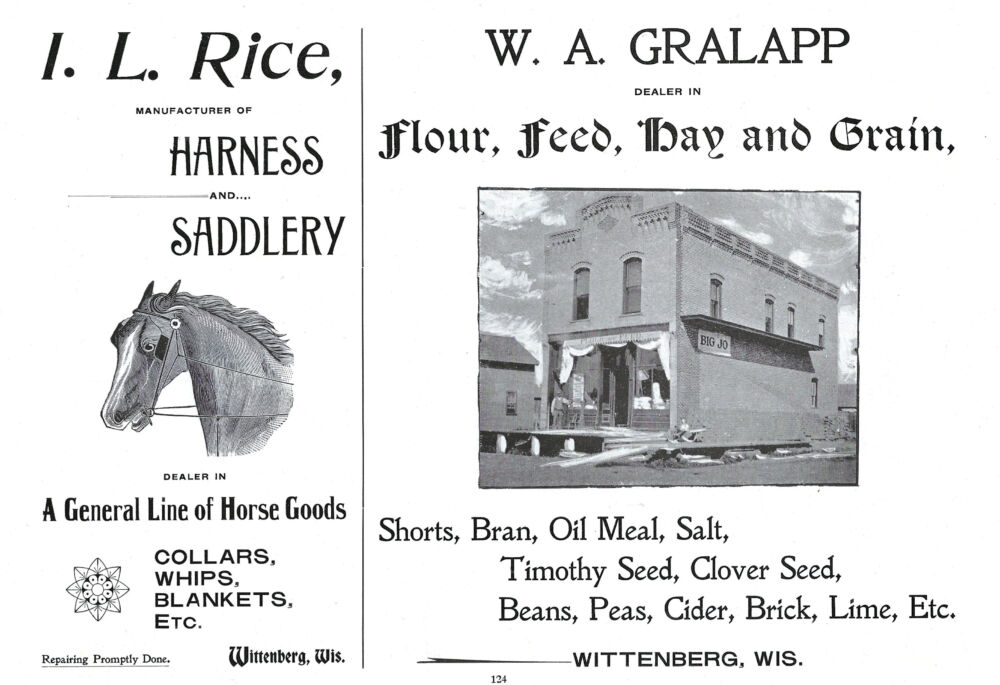
From the Atlas, all direct quotations will be Italicized, some exerpted:
Shawano county is a portion of that vast and magnificent domain, of which the Menominee tribe of Indians were in possession when the white man first set foot on Wisconsin soil. Furthermore, it was then a portion of that great pine region that has poured its wealth down the Wolf to build up the Winnebago lake cities, and lay the foundations of many fortunes outside its borders.
It is considered probable that some of the early Jesuit missionaries were the first white men who ever set foot on the soil of Shawano County. The first white settler was Chas. D Wescott, who is still living on his farm in the town of Richmond, a short distance north of the city of Shawano. In the spring of 1843, Samuel Farnsworth employed Mr. Wescott and a small crew of men at Green Bay to build a saw mill on Wolf River. Shortly after his arrival Mr. Wescott planted some potatoes on the land now owned by J.A. Winans, north of the mill pond. This was the first soil broken for crop in the county by a white man. The mill is located near where the old Kast mill now stands. It subsequently passed into the hands of J.C. Lewis, but Mr. Wescott continued in charge for eight years.
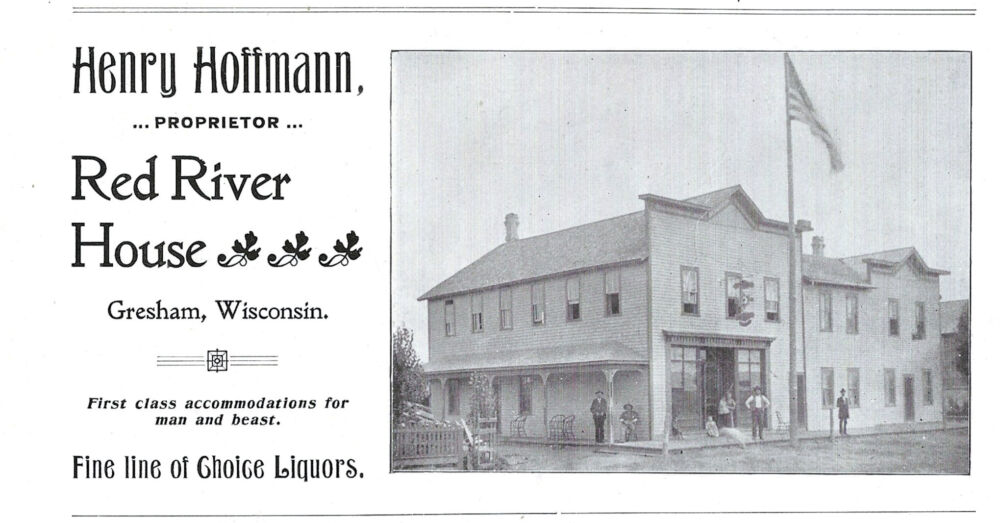
The first meeting of the county board that appears of record was held November 13, 1855, and the accounts and charges against the county for the year 1854 were audited and settled at the time. Order No. 1 for the sum of $4.00 was drawn in favor of Chas. D. Wescott. In all, eleven orders were drawn amounting to the sum of $135.50. The settlement with the county treasurer show that state and county taxes to the amount of $355.60 had been collected, that the sum of $41.57 remained in the hands of the treasurer subject to the order of the board of supervisors, and that a school fund of $103.48 had also been collected. The treasurer’s fees amounted to the magnificent sum of $3.00.
The first newspaper, called the “Venture”, was started by W.C. Thompkins in 1858, and A.J. Rockwell was the first editor. It proved to be a success and was soon sold to a stock company, the name changed to “Shawano County Journal”.
The early history of Shawano county includes the unusual story of wild cat schemes, chief of these being the city of Osceola, a paper metropolis, located on what is now known as White Lake, in the towns of Hartland and Lessor, surrounded at the time by miles of unbroken wilderness. Mortgages on quarter sections of land adjacent to this imaginary city were floated in the East for thousands of dollars.
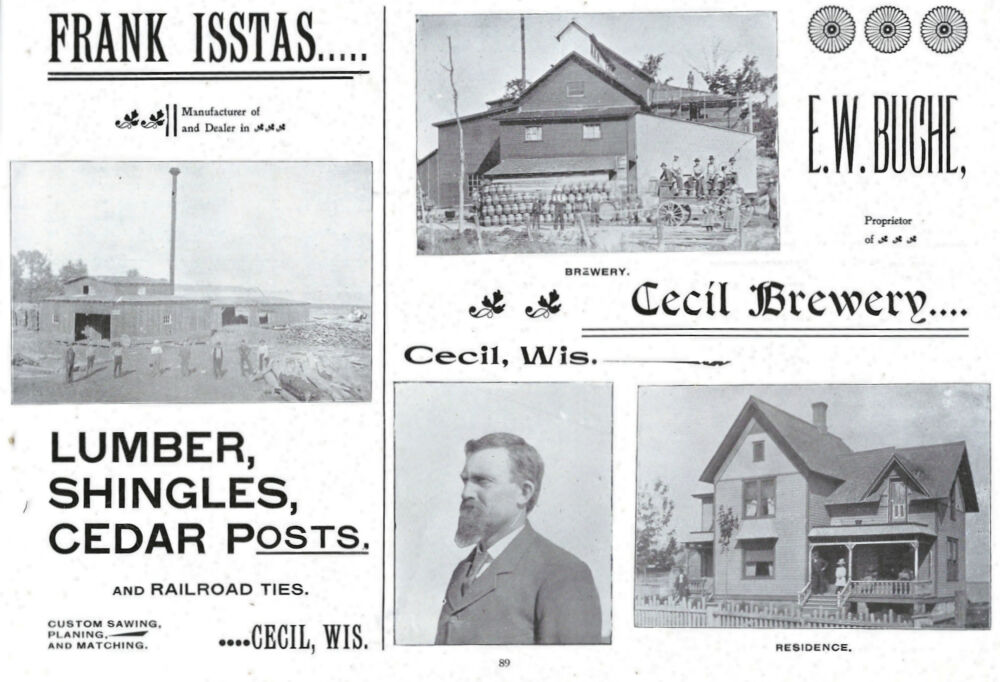
The Federal census of 1860 gave the county a population of 829, showing a gain of 575 in five years; and about this time Shawano County entered a new era in its development. By legislative enactment, “Shawano” was made the authorized way to spell the names, instead of “Shawanaw”.
Indian trails and the Wolf River were the only thoroughfares of the early settlers. The first mails from Green Bay were packed over the old Indian trail. What passed for a wagon trail was opened between Shawano and New London sometime in the 1850s, and about the year 1866 the “military road” was completed between Shawano and Green Bay. Until the present railroad was built in 1884, communication was maintained with the outside world by means of stages running to New London, Shioc and Green Bay.
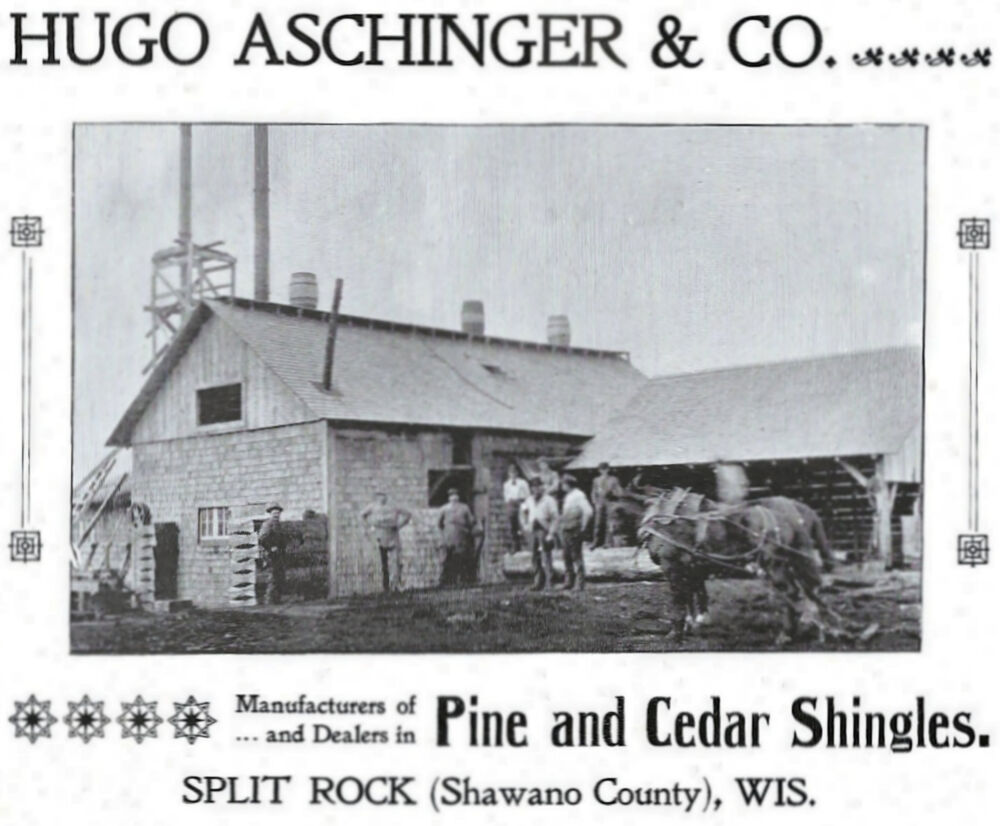
The extensive swamps of the southeastern part of the county have all been burned over, and many of them drained and cultivated. It is interesting to note that the extensive swamps referred to are mostly in the town of Navarino, and have made that town a subject for ridicule in the past; but the exhaustless fertility of the swamp lands that have been reclaimed, strongly indicates that Navarino may eventually become the richest town in the county.
The educational facilities of Shawano county rank with the best in the state. There are 108 public schools with 9,483 children of school age in the county. The schools employ a force of 124 teachers at an average salary, for males $36.10 per month, females $27.37 per month.
*****************

 PRESIDENT’S MESSAGE – JESSE BORLAN
Happy Spring, or at least I’m hoping Spring is finally here once you receive this. We are excited for another year of sharing Shawano County’s history. This year we are also celebrating the 250th birthday of the United States of America. Although we are currently living in turbulent times, we must remember that our ancestors also overcame trial and tribulations and persevered.
This past year the society has lost several volunteers who I had worked along side with for many years, including Rita Trinko, Lorna Dumke, Judy Ebert, and Elaine Knope. Whether it was being a docent during school tours, working in the archives, or volunteering at Rhubarb Fest, we will always remember their smiling faces and warm hearts.
I would like to thank Tom Aumann for his many years of devoted service, both as a volunteer and board member. Tom has been the driving force of the Headstone cemetery walks for the past five years, as well as running the bar at Rhubarb Fest and a steadfast docent in the Zachow Depot. I would like to wish him well in his retirement.
I would also like to welcome Catherine White to our board of directors. I have enjoyed her input the past few months since her appointment in November and look forward to a wonderful working relationship.
We have many exciting things happening this Spring/Summer, including our 18th Annual Rhubarb Festival on June 20th. This year we will also be hosting a part of the History Maker’s Tour in partnership with the Wisconsin Historical Society, which you can read more about in the separate article in this newsletter.
This year I am encouraging you to come visit us. Whether it’s for a Saturday tour, research in the archives, eating rhubarb desserts, or strolling down main street learning about the history of Shawano.
Jesse Borlen, President
****************
GUIDING THE SOCIETY
VISION STATEMENT
The vision of the the Shawano County Historical Society to “enrich people’s lives through history.”
MISSION STATEMENT
The mission of the the Shawano County Historical Society is to “preserve the culture and history or Shawano County by creating a vibrant learning experience and serving as a resource for current and future generations”.
*****************
SHAWANO COUNTY HISTORICAL SOCIETY
2025-26 BOARD OF DIRECTORS
Jesse Borlen, President
Mike Rindt, Vice-President
Mike Eidahl, Secretary
Lana Buelow, Treasurer
Brian Carroll
Priscilla King
Mike Oberle
Dean Proper
Ron Schumacher
Cheryl Tiegs
Catherine White
Newsletter, Jim and Pat Kasten
*****************
Annual Meeting
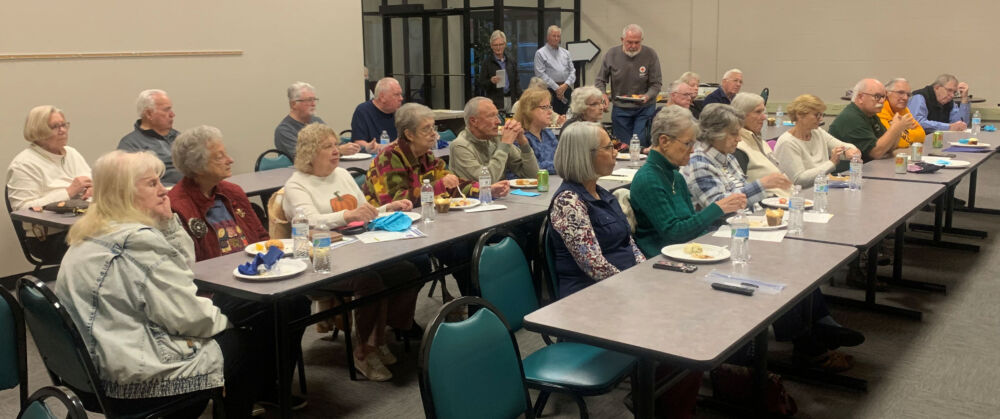
Shawano County Historical Society concluded its 84th year and the set the table for its 85th with its annual meeting on October 20, Elizabeth Street Business Complex, Shawano. Attendees, members and guests, received reports from the President/Curator Jesse Borlen, Treasurer Lana Buelow, retiring Director Tom Aumann and Website Administrator Mike Oberle.
Aumann reviewed the 2025 Headstones presentation held annually at the Woodland Cemetery in September. This year’s tribute was in honor of the Viet Nam veterans of Shawano County featuring: Cpl Bruce J. Guex, Sgt Allan E. Singer, Sgt Larry Govine and Spec4 Ralph “Smokey” Fredenberg. Aumann indicated there are more than 600 Viet Nam era veterans in Shawano County. The Headstones project of the Historical Society, in alliance with county veterans’ organizations, has been commanded by Aumann for several years commemorating the service of Shawano County military service veterans of the United States Civil War, World War I, World War II, Korean, and this year Viet Nam. He noted that there are 74 veterans of the Civil War interred in Woodland.
Buelow’s extensive financial report, including operating and balance sheet summaries, revealed that the Society’s main funds-raiser – RhubarbFest – net income was down slightly in 2025, probably due to it being an unseasonably warm and windy June day, but still produced $17,000.
Borlen thanked attendees for their support and discussed the overall well being of the SCHS. He encourage members and guests to help attract more community organizational and individual volunteer participation. He asserted that the most pressing need is for more storage and historical materials displace space. (Heritage Park does not house a museum per se, but is the site of several historical buildings in which displays are curated.)
Oberle reported that visitors to SCHS’s website continue to increase averaging more than one thousand per month. He also indicated there are now nineteen plaques on downtown Shawano historical buildings with several more gaining commitment to be installed. The Shawano Has History project was developed and coordinated by Leadership Shawano County.
Directors elected to the board were Borlen, Oberle and Cherly Tiegs.
*****************
Novitiate Take Over
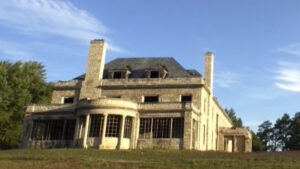
The grandeur of The Novitiate on the Red River.
New Year’s Eve 1974 has been indelibly imprinted in the Shawano-Menominee Community psyche, even these decades later. On that December 31 evening a small group of Menominee tribal members took over the twenty room mansion known locally as The Novitiate on the Red River between Shawano and Gresham. The estate overlooking a beautiful, rocky rapids on the Red was built by a wealthy New Yorker as a personal retreat and later transferred to the Alexian Brothers of the Catholic Church to be used as a monastery, thus, the name Novitiate. Prior to the take-over it had been abandoned by the Alexians, stood empty, with only a caretaker on premises.
The young men involved in the take-over were armed and called themselves the Menominee Warrior Society. Their occupation lasted 34 days into 1975. During those days the lives and livelihoods of farmers and residents on Butternut Road were disrupted as it was heavily guarded by local law enforcement and Wisconsin National Guard personnel in response to sporadic gun fire and threats of violence.
Wisconsin Governor Patrick Lucey had dispatched the Guard to control the situation so there “would be no loss of life”. Some ad hoc citizens groups had formed and staged counter-protests believing that the Guard and law enforcement were not doing enough to end the take-over.
The Shawano community was regularly visited by area, state and national media representatives. Also, by movie actor Marlon Brando, Milwaukee social activist Father James Groppi and leaders of the American Indian Movement (AIM).
The tribe’s Menominee Restoration Committee opposed the take-over and after thirty-four days of the standoff the Alexians reached an agreement with the Warrior Society to end the situation; agreeing to turn the property over to the Menominee Nation for $1.00 and “other considerations”.
Fortunately, there were no fatalities, with injuries no more than frostbite, however, the Mansion was left in shambles.
Termination and Restoration
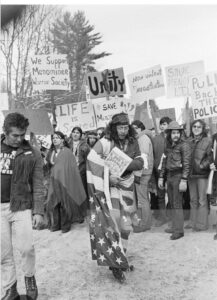
Menominee Warriors Society and supporters during the height of the “take over” event.
“Termination” and “Restoration” were two words and two actions which were part of everyday conversations in Shawano and Menominee Counties during the 1960s and 70s. Both very complex.
In 1954, the U.S. Congress passed legislation – some labeled it an experiment – called Termination. This meant Congress wanted Indian Reservation land to be accessible to non-tribal persons to purchase land on which they would pay taxes. The Menominee people and reservation were chosen by the Bureau of Indian Affairs (BIA) because their logging and lumber business had experienced excellent success: Menominee Tribal Enterprises (MTE), established 1908.
It was during this period that Legend Lake was conceived and developed after the tribe sold land to a Reedsburg, WI developer, N.E. Issacson. The firm had previously developed a successful lake-based home-building property in Sauk County called Lake Redstone. Selling tribal lands got mixed reviews among the Menominee people.
In 1970, an organization called “DRUMS” (Determination of Rights and Unity of Menominee Shareholders) was formed to reverse termination and regain federal recognition as a tribal reservation. On December 22, 1973 President Nixon signed the restoration bill and the long, bitter experiment of termination came to an end.
Next step was the formation of the Menominee Restoration Committee (MRC) which chose Ada Deer as its leader. In 1975, Menominee County reverted back to full reservation status. A new tribal constitution was written, and in 1979 a new tribal government took office. By this time Legend Lake was well established and growing with homes built by Menominees and non-Indians providing a tax base for Menominee County.
****************
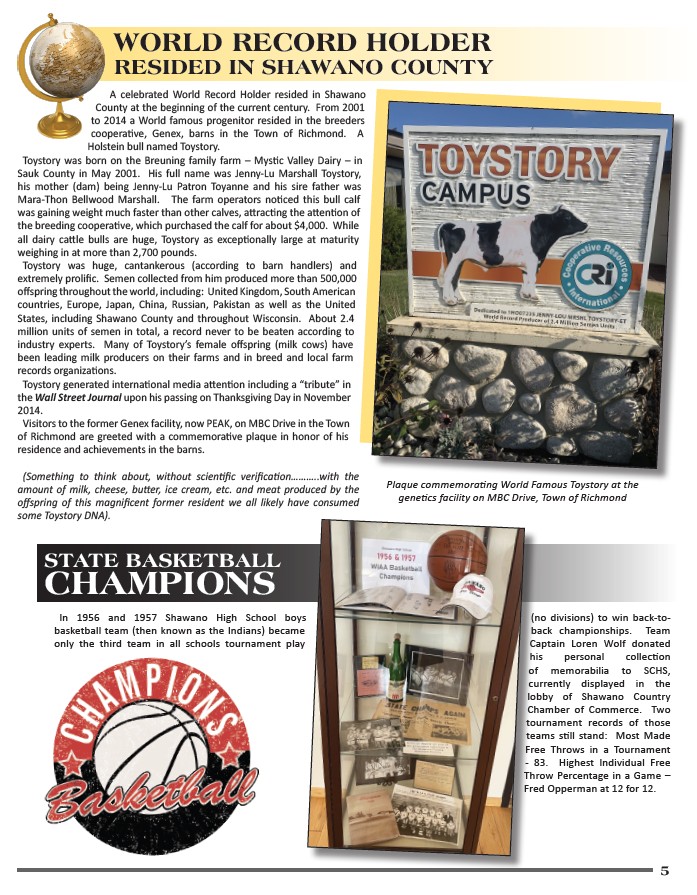
WORLD RECORD HOLDER
RESIDED IN SHAWANO COUNTY
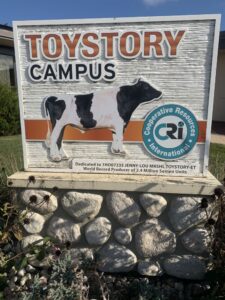
Plaque commemorating World Famous Toystory at the genetics facility on MBC Drive, Town of Richmond.
A celebrated World Record Holder resided in Shawano County at the beginning of the current century. From 2001 to 2014 a World famous progenitor resided in the breeders cooperative, Genex, barns in the Town of Richmond. A Holstein bull named Toystory.
Toystory was born on the Breuning family farm – Mystic Valley Dairy – in Sauk County in May 2001. His full name was Jenny-Lu Marshall Toystory, his mother (dam) being Jenny-Lu Patron Toyanne and his sire father was Mara-Thon Bellwood Marshall. The farm operators noticed this bull calf was gaining weight much faster than other calves, attracting the attention of the breeding cooperative, which purchased the calf for about $4,000. While all dairy cattle bulls are huge, Toystory as exceptionally large at maturity weighing in at more than 2,700 pounds.
Toystory was huge, cantankerous (according to barn handlers) and extremely prolific. Semen collected from him produced more than 500,000 offspring throughout the world, including: United Kingdom, South American countries, Europe, Japan, China, Russian, Pakistan as well as the United States, including Shawano County and throughout Wisconsin. About 2.4 million units of semen in total, a record never to be beaten according to industry experts. Many of Toystory’s female offspring (milk cows) have been leading milk producers on their farms and in breed and local farm records organizations.
Toystory generated international media attention including a “tribute” in the Wall Street Journal upon his passing on Thanksgiving Day in November 2014.
Visitors to the former Genex facility, now PEAK, on MBC Drive in the Town of Richmond are greeted with a commemorative plaque in honor of his residence and achievements in the barns.
(Something to think about, without scientific verification………..with the amount of milk, cheese, butter, ice cream, etc. and meat produced by the offspring of this magnificent former resident we all likely have consumed some Toystory DNA).
****************
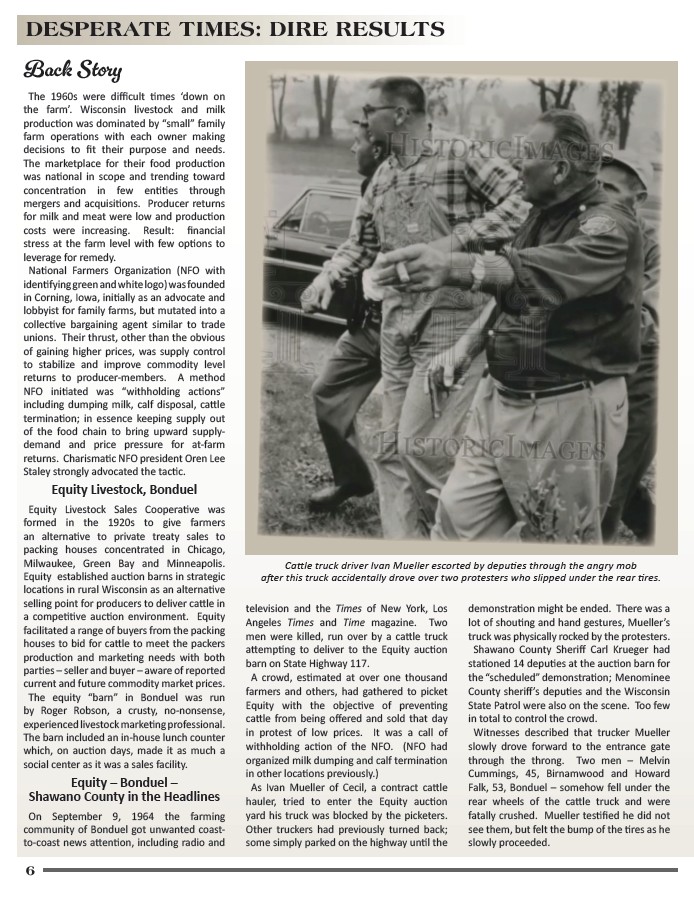
DESPERATE TIMES: DIRE RESULTS
Back Story
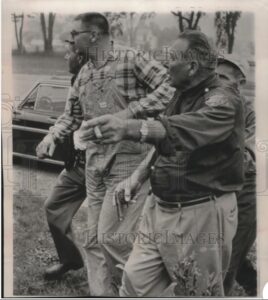
Cattle truck driver Ivan Mueller escorted by deputies through the angry mob after this truck drove over two protesters who slipped under the rear tires.
The 1960s were difficult times ‘down on the farm’. Wisconsin livestock and milk production was dominated by “small” family farm operations with each owner making decisions to fit their purpose and needs. The marketplace for their food production was national in scope and trending toward concentration in few entities through mergers and acquisitions. Producer returns for milk and meat were low and production costs were increasing. Result: financial stress at the farm level with few options to leverage for remedy.
National Farmers Organization (NFO with identifying green and white logo) was founded in Corning, Iowa, initially as an advocate and lobbyist for family farms, but mutated into a collective bargaining agent similar to trade unions. Their thrust, other than the obvious of gaining higher prices, was supply control to stabilize and improve commodity level returns to producer-members. A method NFO initiated was “withholding actions” including dumping milk, calf disposal, cattle termination; in essence keeping supply out of the food chain to bring upward supply-demand and price pressure for at-farm returns. Charismatic NFO president Oren Lee Staley strongly advocated the tactic.
Equity Livestock, Bonduel
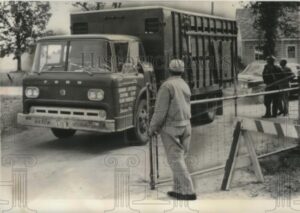
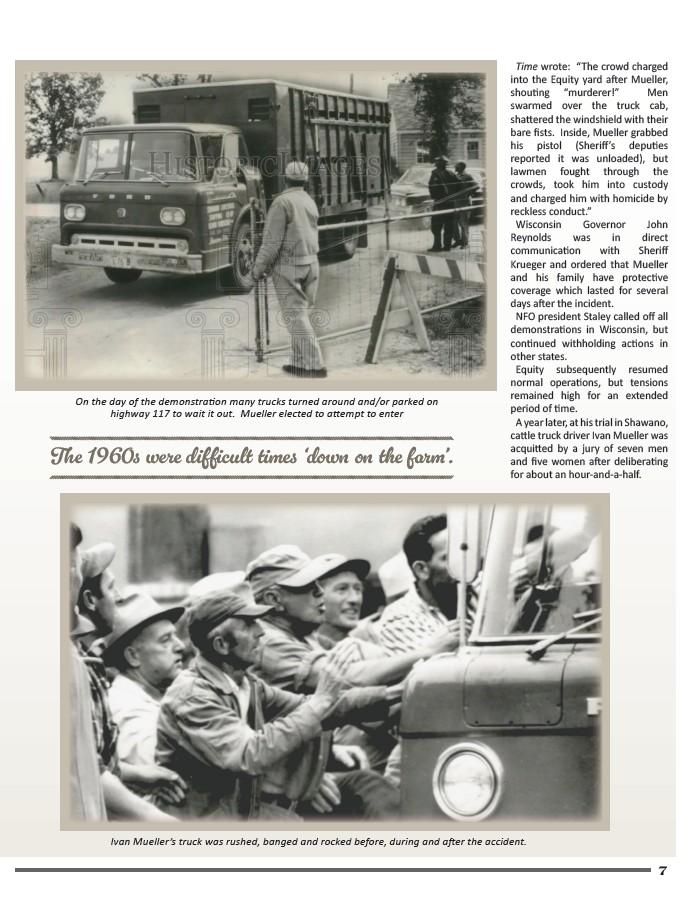
On the day of the demonstration many trucks turned around and/or parked on highway 117 to wait it out. Mueller elected to attempt to enter.
Equity Livestock Sales Cooperative was formed in the 1920s to give farmers an alternative to private treaty sales to packing houses concentrated in Chicago, Milwaukee, Green Bay and Minneapolis. Equity established auction barns in strategic locations in rural Wisconsin as an alternative selling point for producers to deliver cattle in a competitive auction environment. Equity facilitated a range of buyers from the packing houses to bid for cattle to meet the packers production and marketing needs with both parties – seller and buyer – aware of reported current and future commodity market prices.
The equity “barn” in Bonduel was run by Roger Robson, a crusty, no-nonsense, experienced livestock marketing professional. The barn included an in-house lunch counter which, on auction days, made it as much a social center as it was a sales facility.
Equity – Bonduel – Shawano County in the Headlines
On September 9, 1964 the farming community of Bonduel got unwanted coast-to-coast news attention, including radio and television and the Times of New York, Los Angeles Times and Time magazine. Two men were killed, run over by a cattle truck attempting to deliver to the Equity auction barn on State Highway 117.
A crowd, estimated at over one thousand farmers and others, had gathered to picket Equity with the objective of preventing cattle from being offered and sold that day in protest of low prices. It was a call of withholding action of the NFO. (NFO had organized milk dumping and calf termination in other locations previously.)
As Ivan Mueller of Cecil, a contract cattle hauler, tried to enter the Equity auction yard his truck was blocked by the picketers. Other truckers had previously turned back; some simply parked on the highway until the demonstration might be ended. There was a lot of shouting and hand gestures, Mueller’s truck was physically rocked by the protesters.
Shawano County Sheriff Carl Krueger had stationed 14 deputies at the auction barn for the “scheduled” demonstration; Menominee County sheriff’s deputies and the Wisconsin State Patrol were also on the scene. Too few in total to control the crowd.
Witnesses described that trucker Mueller slowly drove forward to the entrance gate through the throng. Two men – Melvin Cummings, 45, Birnamwood and Howard Falk, 53, Bonduel – somehow fell under the rear wheels of the cattle truck and were fatally crushed. Mueller testified he did not see them, but felt the bump of the tires as he slowly proceeded.
Time wrote: “The crowd charged into the Equity yard after Mueller, shouting “murderer!” Men swarmed over the truck cab, shattered the windshield with their bare fists. Inside, Mueller grabbed his pistol (Sheriff’s deputies reported it was unloaded), but lawmen fought through the crowds, took him into custody and charged him with homicide by reckless conduct.”
Wisconsin Governor John Reynolds was in direct communication with Sheriff Krueger and ordered that Mueller and his family have protective coverage which lasted for several days after the incident.
NFO president Staley called off all demonstrations in Wisconsin, but continued withholding actions in other states.
Equity subsequently resumed normal operations, but tensions remained high for an extended period of time.
A year later, at his trial in Shawano, cattle truck driver Ivan Mueller was acquitted by a jury of seven men and five women after deliberating for about an hour-and-a-half.
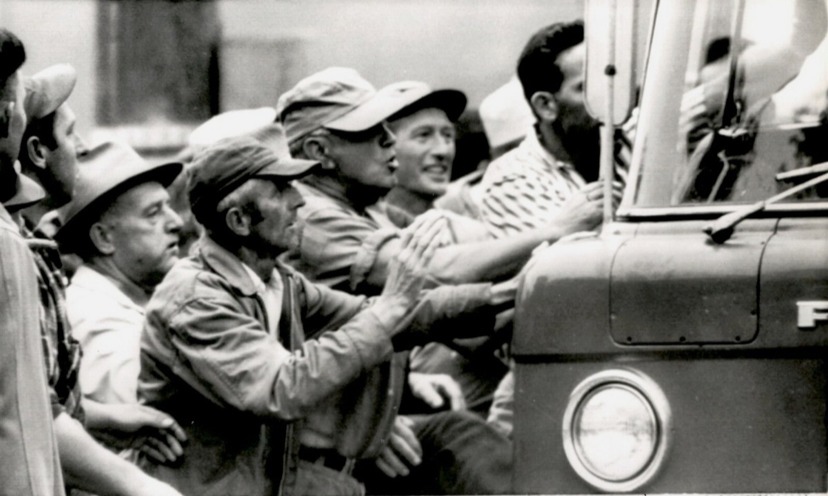
Ivan Mueller’s truck was rushed, bangied and rocked before, during, and after the accident.
*****************
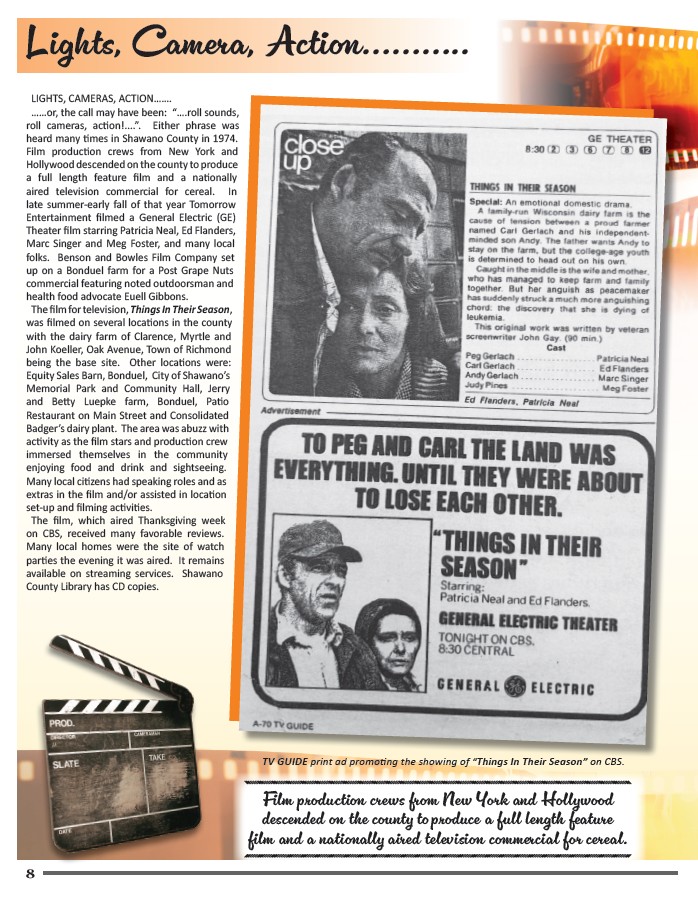
Lights, Camera, Action………..
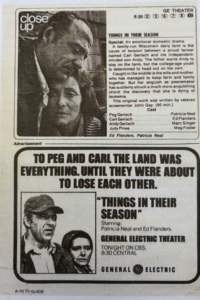
TV GUIDE print ad promoting the showing of “Things In Their Seasoln” on CBS.
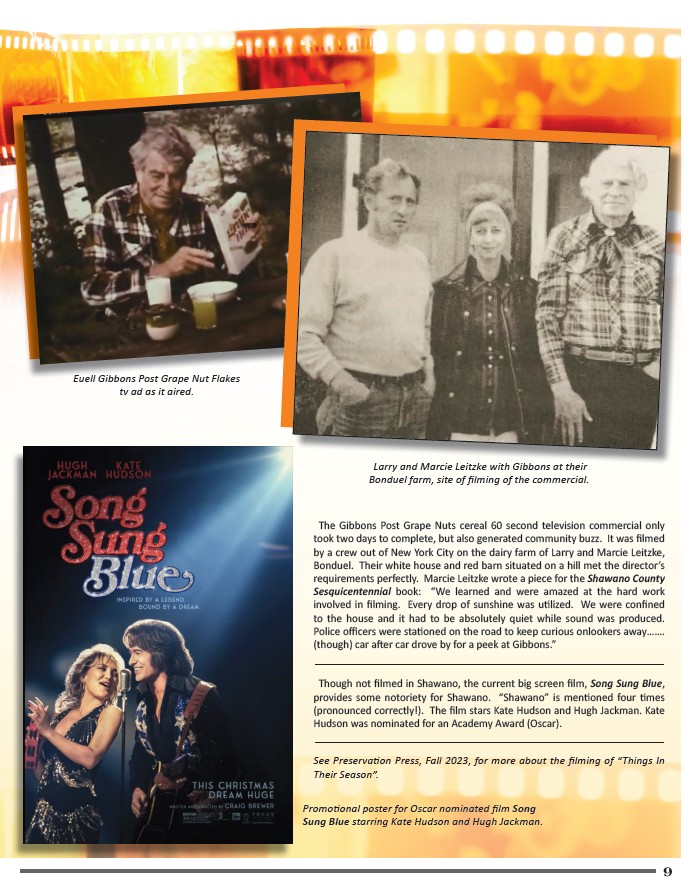
……or, the call may have been: “….roll sounds, roll cameras, action!….”. Either phrase was heard many times in Shawano County in 1974. Film production crews from New York and Hollywood descended on the county to produce a full length feature film and a nationally aired television commercial for cereal. In late summer-early fall of that year Tomorrow Entertainment filmed a General Electric (GE) Theater film starring Patricia Neal, Ed Flanders, Marc Singer and Meg Foster, and many local folks. Benson and Bowles Film Company set up on a Bonduel farm for a Post Grape Nuts commercial featuring noted outdoorsman and health food advocate Euell Gibbons.
The film for television, Things In Their Season, was filmed on several locations in the county with the dairy farm of Clarence, Myrtle and John Koeller, Oak Avenue, Town of Richmond being the base site. Other locations were: Equity Sales Barn, Bonduel, City of Shawano’s Memorial Park and Community Hall, Jerry and Betty Luepke farm, Bonduel, Patio Restaurant on Main Street and Consolidated Badger’s dairy plant. The area was abuzz with activity as the film stars and production crew immersed themselves in the community enjoying food and drink and sightseeing. Many local citizens had speaking roles and as extras in the film and/or assisted in location set-up and filming activities.
The film, which aired Thanksgiving week on CBS, received many favorable reviews. Many local homes were the site of watch parties the evening it was aired. It remains available on streaming services. Shawano County Library has CD copies.
_________________________________________
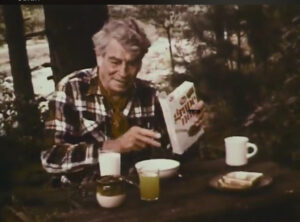
Euell Gibbons Post Grape Nuts Flakes TV ad as it aired.
The Gibbons Post Grape Nuts cereal 60 second television commercial only took two days to complete, but also generated community buzz. It was filmed by a crew out of New York City on the dairy farm of Larry and Marcie Leitzke, Bonduel. Their white house and red barn situated on a hill met the director’s requirements perfectly. Marcie Leitzke wrote a piece for the Shawano County Sesquicentennial book: “We learned and were amazed at the hard work involved in filming. Every drop of sunshine was utilized. We were confined to the house and it had to be absolutely quiet while sound was produced. Police officers were stationed on the road to keep curious onlookers away…….(though) car after car drove by for a peek at Gibbons.”
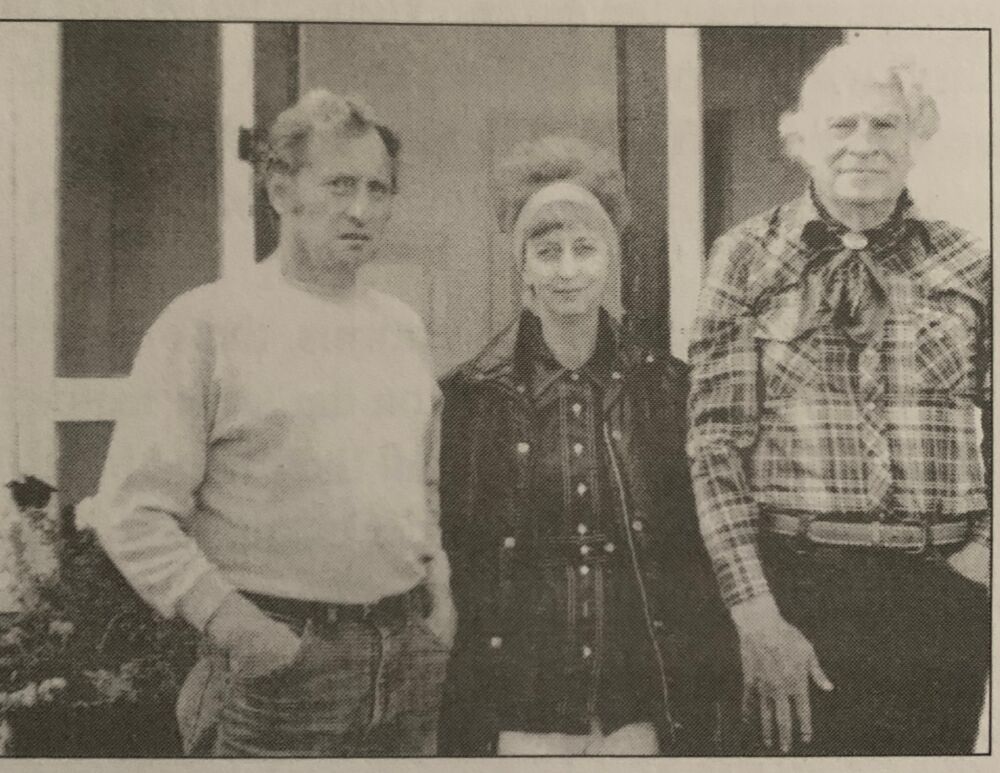
Larry and Marcie Leitzke with Gibbons at their Bonduel farm, site of filming of the commercial.
_________________________________________
Promotional poster for Oscar nominated film Song Sung Blue starring Kate Hudson and Hugh Jackman.
Though not filmed in Shawano, the current big screen film, Song Sung Blue, provides some notoriety for Shawano. “Shawano” is mentioned four times (pronounced correctly!). The film stars Kate Hudson and Hugh Jackman. Kate Hudson was nominated for an Academy Award (Oscar).
See Preservation Press, Fall 2023, for more about the filming of Things In Their Season.
****************
100 YEARS AND COUNTING
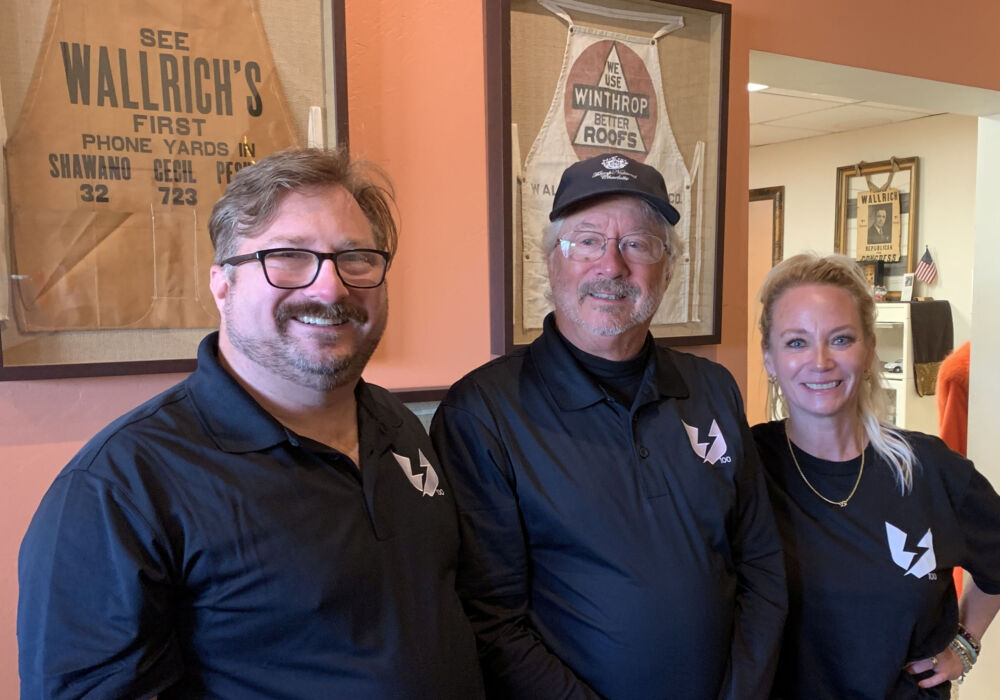
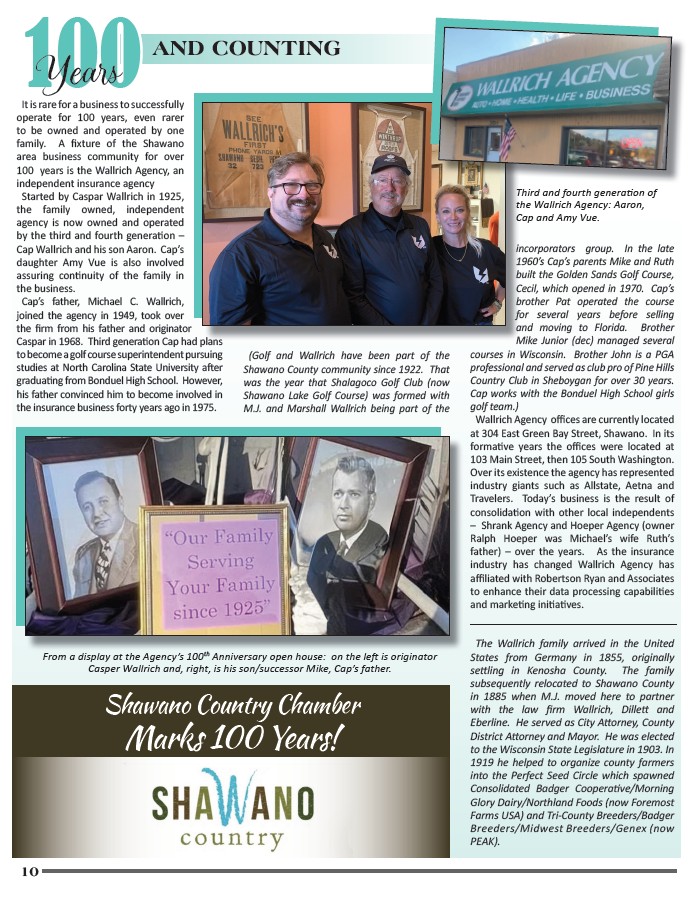
Third and fourth generations of the Wallrich Agency: Aaron, Cap, and Amy Vue.
It is rare for a business to successfully operate for 100 years, even rarer to be owned and operated by one family. A fixture of the Shawano area business community for over 100 years is the Wallrich Agency, an independent insurance agency
Started by Caspar Wallrich in 1925, the family owned, independent agency is now owned and operated by the third and fourth generation – Cap Wallrich and his son Aaron. Cap’s daughter Amy Vue is also involved assuring continuity of the family in the business.
Cap’s father, Michael C. Wallrich, joined the agency in 1949, took over the firm from his father and originator Caspar in 1968. Third generation Cap had plans to become a golf course superintendent pursuing studies at North Carolina State University after graduating from Bonduel High School. However, his father convinced him to become involved in the insurance business forty years ago in 1975.
 Golf and Wallrich have been part of the Shawano County community since 1922. That was the year that Shalagoco Golf Club (now Shawano Lake Golf Course) was formed with M.J. and Marshall Wallrich being part of the incorporators group. In the late 1960’s Cap’s parents Mike and Ruth built the Golden Sands Golf Course, Cecil, which opened in 1970. Cap’s brother Pat operated the course for several years before selling and moving to Florida. Brother Mike Junior (dec) managed several courses in Wisconsin. Brother John is a PGA professional and served as club pro of Pine Hills Country Club in Sheboygan for over 30 years. Cap works with the Bonduel High School girls golf team.
Wallrich Agency offices are currently located at 304 East Green Bay Street, Shawano. In its formative years the offices were located at 103 Main Street, then 105 South Washington. Over its existence the agency has represented industry giants such as Allstate, Aetna and Travelers. Today’s business is the result of consolidation with other local independents – Shrank Agency and Hoeper Agency (owner Ralph Hoeper was Michael’s wife Ruth’s father) – over the years. As the insurance industry has changed Wallrich Agency has affiliated with Robertson Ryan and Associates to enhance their data processing capabilities and marketing initiatives.
The Wallrich family arrived in the United States from Germany in 1855, originally settling in Kenosha County. The family subsequently relocated to Shawano County in 1885 when M.J. moved here to partner with the law firm Wallrich, Dillett and Eberline. He served as City Attorney, County District Attorney and Mayor. He was elected to the Wisconsin State Legislature in 1903. In 1919 he helped to organize county farmers into the Perfect Seed Circle which spawned Consolidated Badger Cooperative/Morning Glory Dairy/Northland Foods (now Foremost Farms USA) and Tri-County Breeders/Badger Breeders/Midwest Breeders/Genex (now PEAK).
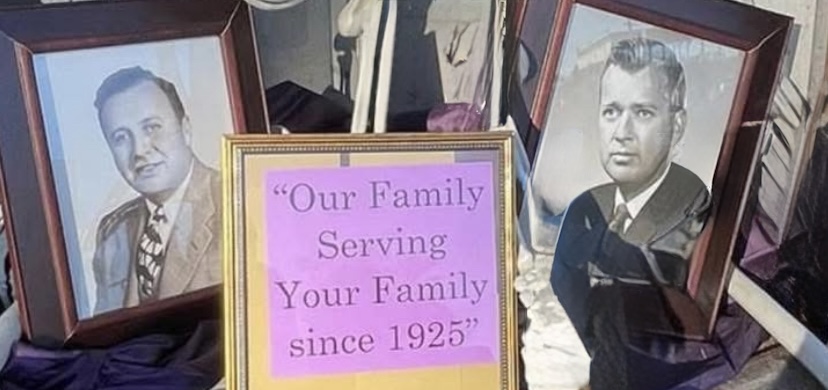
From a display at the Agency’s 100th Anniversary open house: on the left is originatorCasper Wallrich and , right, is his son/successor Mike, Cap’s father.
*****************

Displays and activities will be conducted by The Wisconsin Historical Society, April 27th – July 10th at Heritage Park, Shawano.
*****************
Rhubarb Fest 2025
Save the date: Saturday June 20, 2026
Our Thanks for These Donations
Received September 23, 2025 – March 16, 2026
Memberships
Lifetime – $1,250
Guardian – $250
- Peter Voy
- Stephen Fellman
- Catharine White
Premier – $100
- Greg & Lesley Nemetz
- Tom & Karen Grover
- Richard & JudyAnn Pahlow
- Barbara Mortensen
- Lloyd & Carolyn Gutt
- James & Judith Judd
- Bonnie Sperberg
New Members
- Joe Dillenberg
- Catharine White
Memorials
In memory of:
- Bill Hoppe
- Elaine Knope
Cash Donations
- Dean Proper – $5,000
- Sue Mitton Petru – $2,000
- Timothy & Barbara Schmid – $500
- Joann Stein – $100
- Herbert Grover – $100
America Online Giving – Chad Voelker
Thrivent Choice – Sandra Carroll
*****************
MEMBERSHIP HAS BENEFITS!
If you aren’t already a member, consider joining now. Membership donations are an important part of generating operating funds. Join now through our website www.shawanohistory.com “Membership” link.
A change is coming October 1st. A base fee of $20.00 will apply for non-members requesting Research Assistance. Research will begin after receipt of payment and covers search time, regardless of whether the search is successful. Staff will spend up to 60 minutes per request plus $.25 per page for copies.
Research requests can be submitted through the “Contact Us” link on our website and completing the Research Assistance form with your questions or comments.
*****************
WAYS YOU CAN HELP US FINANCIALLY
- Membership: Consider upgrading to a higher membership level when you receive your annual renewal information by mail. Encourage friends and family to join.
- Cash Donations: Monetary donations help us maintain historical documents and artifacts, adhere to professional museum and archival standards, maintain museum buildings, and pay operating expenses.
- In-kind Donations: Donations of goods and services allow us to keep operating expenses low and use the funds we raise for our programs and historic preservation.
- Other Ways to Donate
- Utilize employer donation matching programs to benefit SCHS, such as Benevity Causes (Prudential), Thrivent Your Cause, Prevea Circle of Giving, ThedaCare community volunteer program.
- Designate SCHS to receive merchant charity donations, such as Amazon Smile and Thrivent Choice Dollars.
- Memorials on behalf of a missed loved one
- Community Foundation grants
- A gift of appreciated stocks, bonds, or real estate to the SCHS eliminates federal taxes on capital gains.
- Use your required minimum distribution from your IRA as a tax free gift.
- Make the SCHS a beneficiary of a percentage of your IRA, 401k, annuity, will, or trust.
Membership and Donations available online at www.shawanohistory.org

 |
 |