Location
Photo Gallery

Waukechon Village Eagle.
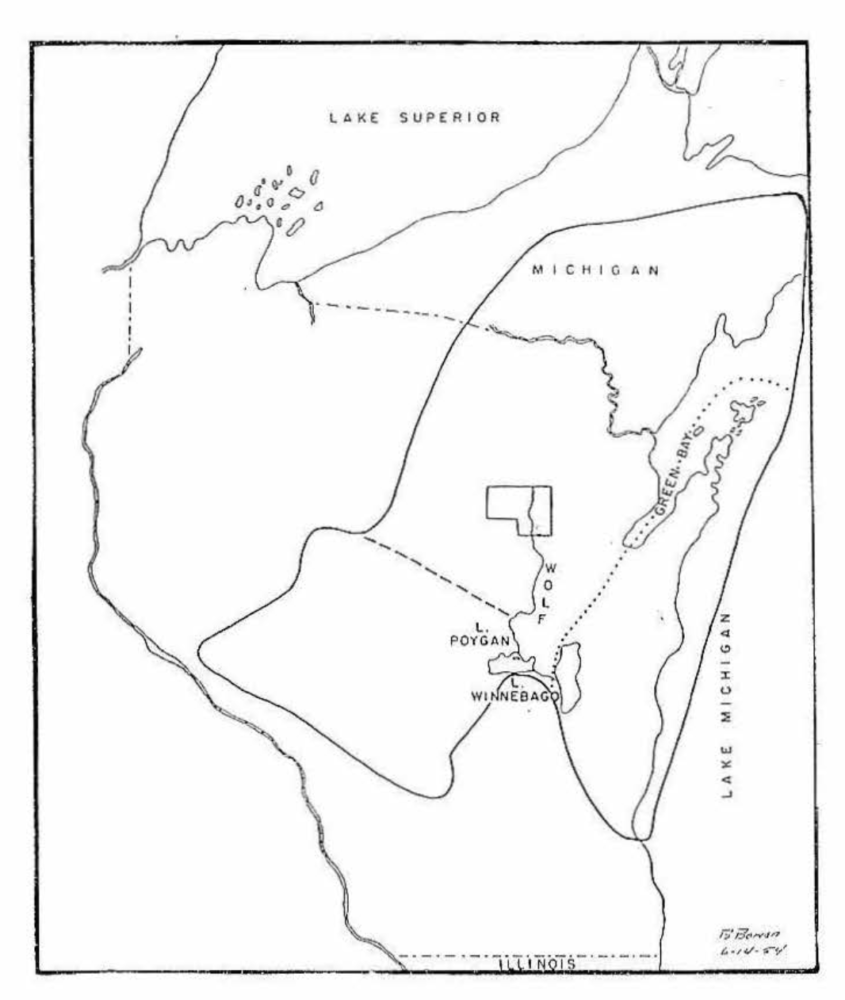
June 1954 Waukechon Village map.
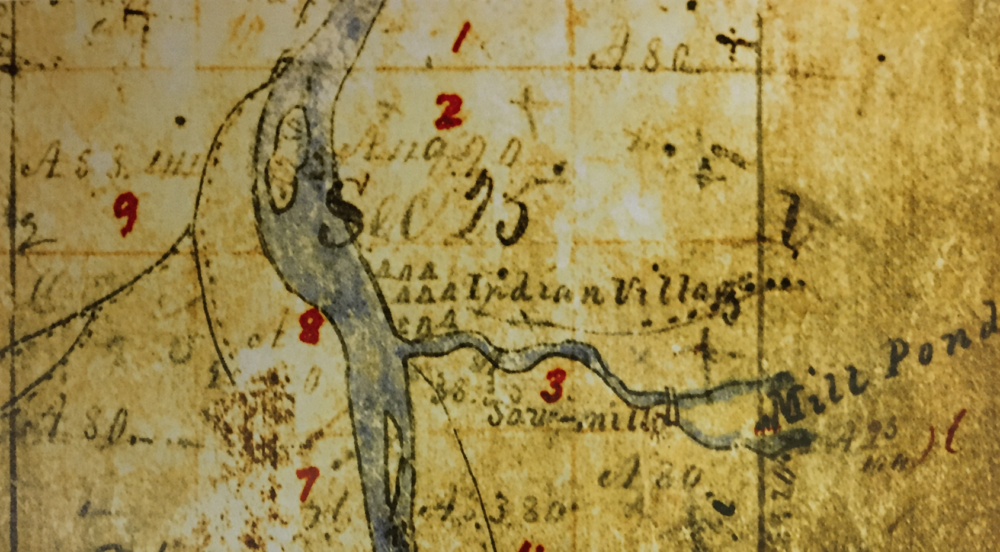
1879 map showing the Menominee Nation Waukechon Village.
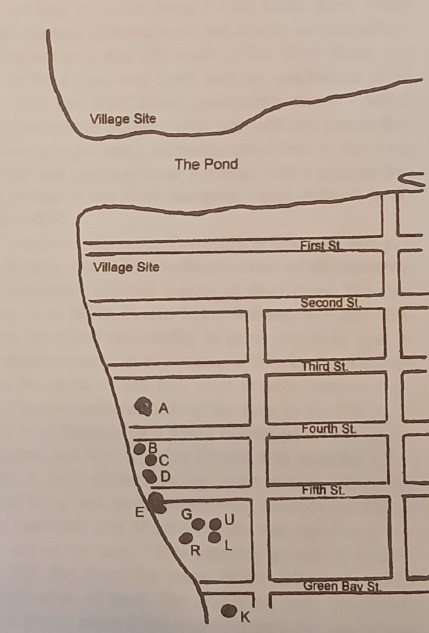
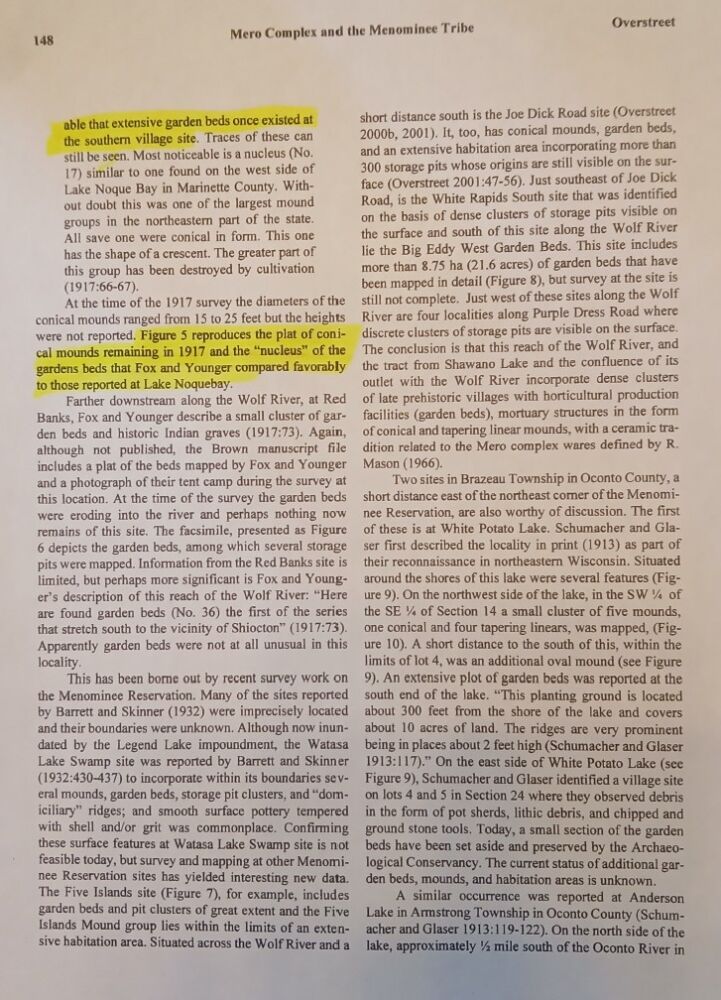
The conclusion is that this reach of the Wolf River, and the tract from Shawano Lake and the confluence of its outlet with the Wolf River incorporate dense clusters of late prehistoric villages with horticultural production facilities (garden beds), mortuary structures in the form of conical and tapering linear mounds, with a ceramic tradition related to the Mero complex wares defined by R. Mason (1966).
A Brief History
Menominee Ancestral Lands – Waukechon Village Site
609 N. Bartlett Street
Shawano, Wisconsin
The land you are standing upon has a rich history. It is part of more than ten million acres that comprised the ancestral land base of the Menominee Nation. For thousands of years, Menominee people lived upon and cared for this land. Their continuous effort as caretakers is the reason that the Wolf River remains to be one of the most pristine waterways in the state of Wisconsin, as well as why the Menominee forest north of this site is known internationally as a testament to the wisdom of sustainable Indigenous forestry practices.
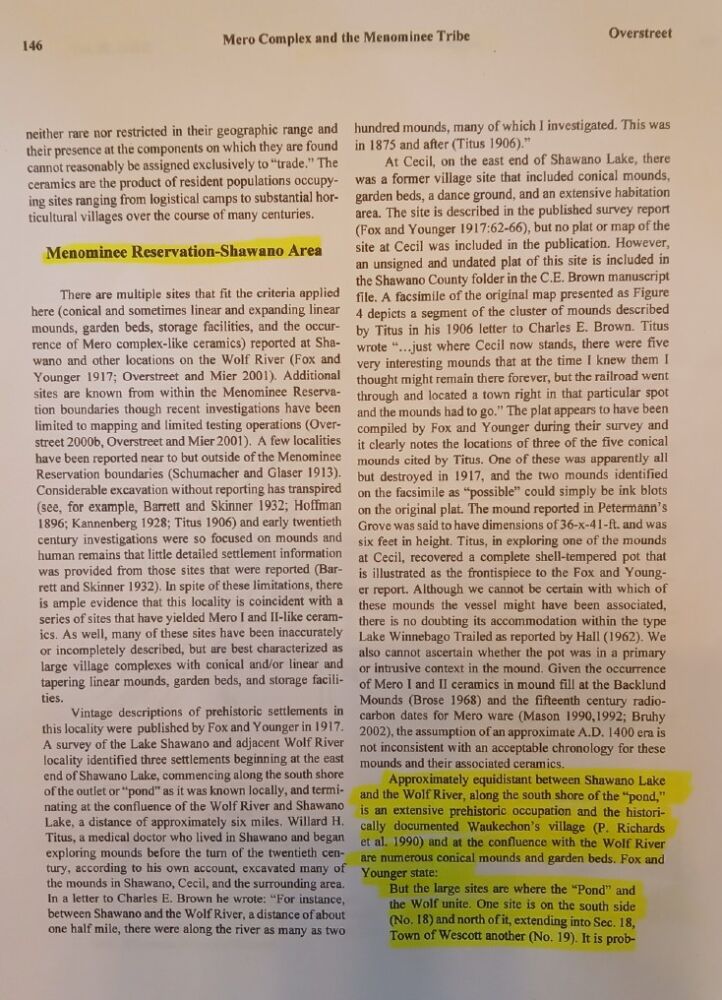
Prior to contact with Europeans, this site was known to the Menominee people as the Waukechon Village. Archeological research in the late 19th and early 20th centuries revealed that the settlement spanned from the Shawano Lake Outlet to what is now Green Bay Street on the banks of the Wolf River. The Waukechon Village had a clearly defined infrastructure that included housing, horticultural garden beds, and mortuary structures in the form of conical and tapering linear mounds. This area was like many other village sites along the Wolf, Wisconsin, Fox, and Menominee Rivers, proving Menominee culture has thrived for centuries. This site in particular was a place where sturgeon were speared by Menominee people prior to the dam being built.
Menominee Historic Preservation reports that Chief Waukechon belonged to the “Thunderer’s” otōtāēm. Some historians have translated his name as “Crooked Nose,” however, according to Menominee elders it means “Crooked Beak,” denoting the beak of an eagle or hawk. Although it is unknown where he was born, Chief Waukechon was the son of Wanesot and is known to have been respected by the other Menominee Band Leaders. Chief Waukechon was an important voice during the Menominee Treaty Era.
The Menominee people are known for their diplomacy both before and after their contact with European settlers. Both written and oral records convey that they practiced apēkon ahkīhih, which is the plural command to “sit upon the land” and partake of Menominee hospitality. Native Nations such as the Ojibwe partook in apēkon ahkīhih prior to recorded time, and European settlers such as the French have resided here since 1672. However, the first permanent non-Native settlement was not until 1844, which was during the time when the United States of America sought ownership of this land.
Between 1831 and 1856, under the threat of forced removal, the Menominee Nation signed treaties with the United States of America that reduced Menominee land holdings from ten million acres to the two hundred-thirty-four thousand acres which the Menominee people retain to this day. The Menominee Nation ceded lands that comprise much of what is now the eastern and central portions of Wisconsin, as well as part of Michigan’s Upper Peninsula. Named after either the notable Menominee Chief Sāwanoh or the Menominee word meaning “South” in English, the City of Shawano was founded on February 16, 1853 while this was still Menominee land. This site was ceded to the United States in 1854.
Due to centuries of Menominee land stewardship, what is now the City of Shawano inherited fertile land to support what is now a thriving city. Menominee people sought to care for this land so that their descendants could thrive upon it, and because of their efforts Shawano has enjoyed a lumber industry, agricultural community, and recreational opportunities. Shawano residents have adapted this land to suit their needs, and from 1931 to 2016 the Shawano Medical Center stood upon this site.
The Menominee Nation continues to adapt to changing times while staying rooted in their ancient wisdom. Erected in 2026, this monument is dedicated to the Menominee Nation’s unending care for their ancestral homelands. It tells the story of one of many ancestral sites that are sacred to the Menominee Nation.
Archeological References to the Waukechon Village Site
Overstreet, David F. 2009. “The Mero Complex and the Menominee Tribe: Prospects for a Territorial Ethnicity.”
The Wisconsin Archeologist, Volume 90, Numbers 1 & 2 (January–December 2009), pp. 179–224.
The text about the Menominee lands at the confluence of the Wolf River and the Shawano Lake outlet (“The Pond”) is found in the subsection titled:
Menominee Reservation–Shawano Area
Within that subsection, Overstreet discusses:
- The archaeological evidence for an extensive prehistoric occupation at the confluence of the Wolf River and the Shawano Lake outlet (“The Pond”);
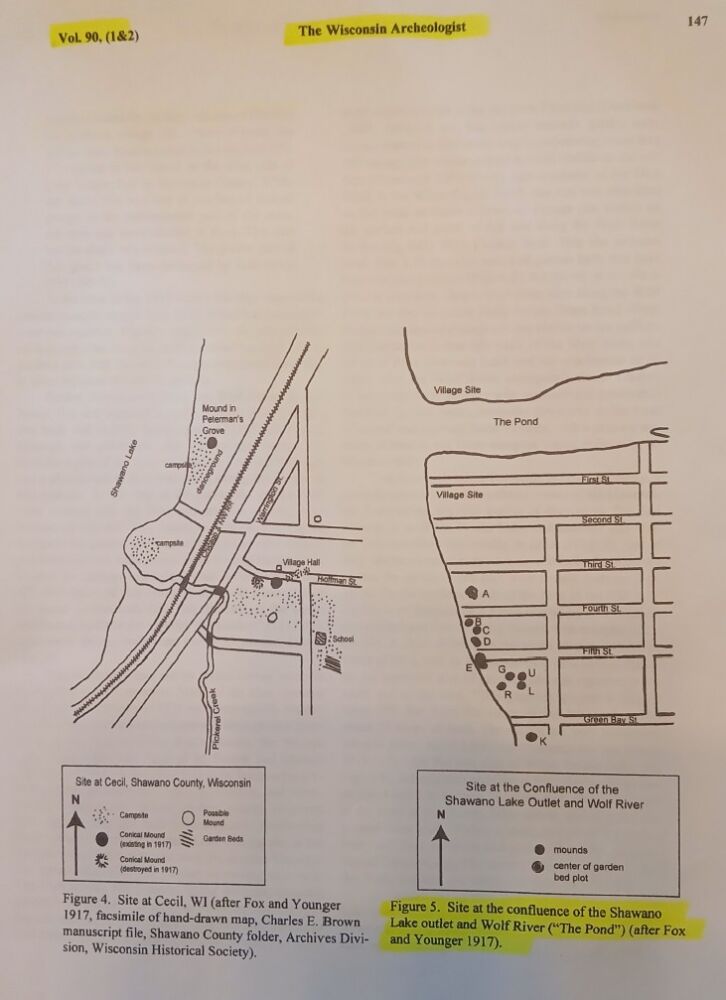
- The garden beds and conical mounds recorded there by Fox and Younger (1917);
- The relationship of these sites to the Menominee Reservation; and
- Figure 5, which maps the mound group and garden beds at the confluence.