
Photo Gallery
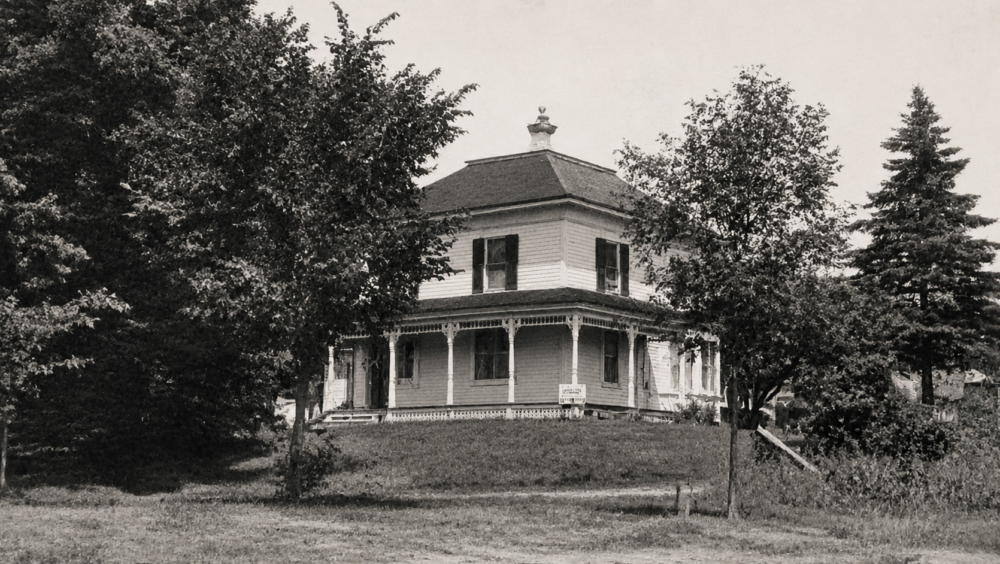
The Wescott Estate, just north of the City of Shawano, on Highway 47.
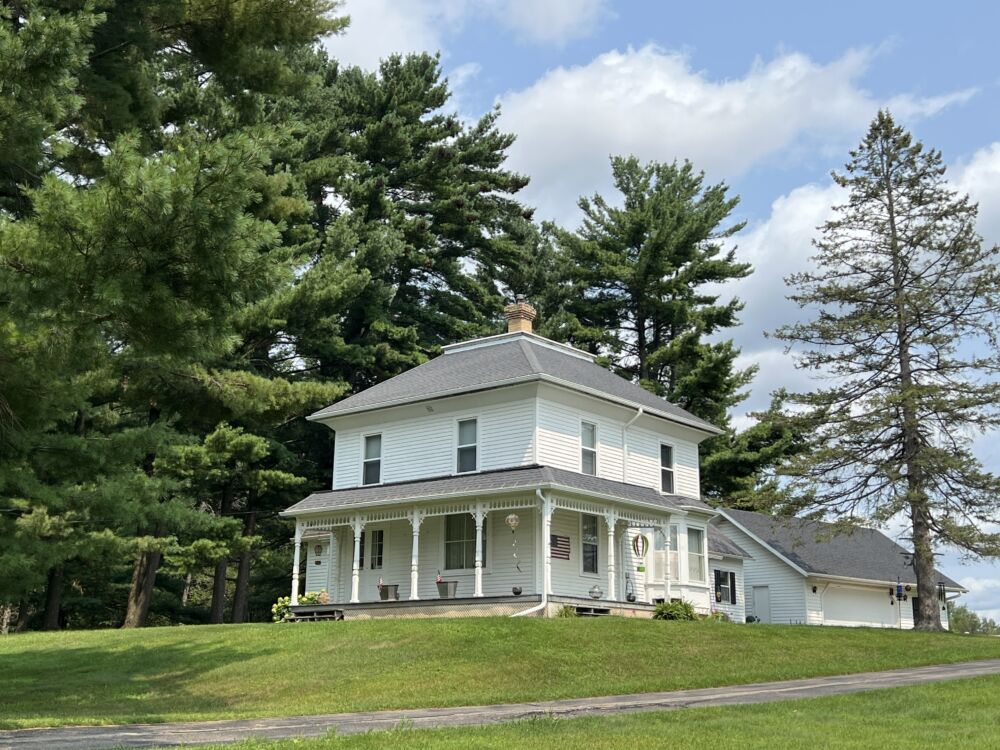
The Wescott Estate, just north of the City of Shawano, on Highway 47 in 2026.
Notes
The Wescott Estate
Shawano, WI
The Wescott home is a landmark in Shawano. The home sits on a hill, behind the Alpine Shores development, directly east of Divine Savior Church.
The home is the oldest house in the area with its exterior in original condition. It was originally constructed of logs with a stone and concrete basement. Later other rooms were added. The bay windows were later added, along with the porches with a brick bracket trim. A modern wood siding renewed the home into the structure visible today. The staircases are original oak. The floors are of solid maple. Several old wood heaters with chrome foot warmers still enhance the house.
The house has a new roof and a modern bathroom. It has a new auxiliary heating system, and its own well. The kitchen has a modern gas stove, but it still also has the original cookstove with a water reservoir. The room still reflects the historical days of wood stoves, and yet may be utilized as a modern kitchen.
The following history of the home and the Wescott families was provided by Steve Smith of Zingle Realty and Auction Co. The sources were an article which appeared in the Feb. 1, 1934 issue of the Shawano County Journal, which detailed a talk given to the Shawano Rotary Club. Smith also used a history written by John Wihans, information from the Shawano Historical Society and both the Shawano County and City of Shawano centennial books.
Charles Wescott came up the Wolf River by boat in 1843. He had been recruited by Samuel Farnsworth, an explorer of the upper Wolf River for lumbering interests, to harvest the vast tracts of virgin pine in the “Country of the Menominees.” Wescott agreed to come into the wilderness to set up a sawmill. All of the machinery was brought up the Wolf from Oshkosh.
The mill was built on the south bank of a beaver dam by an island in the creek that flowed from Shawano Lake (what today is the Channel). Wescott enlarged the dam to create “Pond Lake” to hold the logs for the mill. Pond Lake was later used to steam boats to give rides to Shawano Lake for residents and tourists. The sawmill and a grist mill, added in 1867, operated on that site until 1893 when the “Papermill Dam” was built, flooding the original location.
Charles built a square log cabin about 200 feet north of the dam in the 1840s (the River Heights area). He added a frame house to the west end of the cabin for his wife and children, who reportedly arrived in 1850. A short time later he built the first frame home in Shawano at the west end of what is now Anderson Ave. in the Town of Wescott. That home is reported to be a part of the house that currently stands north of Heritage Hardwoods.
Hiram Wescott, Charles’ brother, arrived from Allegany County, New York, in 1853. He took over the log cabin and adjoining frame house. Hiram was engaged in lumbering and milling too. In 1855 he built the Wescott House, a hotel, at the southwest corner of what is now the intersection of Main and Green Bay streets.
In 1853, ten years after the family’s arrival, organization of the County of Shawano was authorized by the state legislature. The name was later changed to Shawano. The first election was held in the Wescott home. Forty-seven votes were cast. Charles Wescott became the first county chairman. The first City of Shawano election was held 16 years later on April 3, 1871. Hiram Wescott was elected trustee. Charles served as the first postmaster, and remained in that position through the Lincoln Administration.
Eugene reported that “since there were no trout in the Wolf River, they were brought over from the Oconto River and placed in the Wolf,” by Charles’ millworkers. Eldridge Wassott, the father of Charles and Hiram, was the first person to be buried in Ainsworth, near the area where Heritage Hardwoods is now located. Later his remains were moved to the Township of Wescott Cemetery, as it was called then, only to be moved a final time to Pioneer Hill in the Woodlawn Cemetery on East Green Bay Street, where his headstone dated 1861 can still be seen.
As for the house itself, William Grimmer purchased the land on which the Wescott Estate stands today. The original patent from the federal government was recorded March 1, 1864. Grimmer donated part of this parcel to be used for a school. The “Grimmer School” was located at the southeast corner of what is now the intersection of Highways 47 and 80 and County Highway H. That school was renamed the Magee School and later still, the Ainsworth School after Thomas Ainsworth whose daughter married Eugene Wescott.
Thomas Ainsworth served 50 years as superintendent of the Keshena Improvement Association, which operated all of the dams on the Wolf River used by the log drivers in the river days. He married Anna Hisky Jones, a school teacher. It is believed they built the present house where it now stands.
Ainsworth’s daughter, Mary, was born in the upstairs bedroom in the southwest corner of the house, Oct. 5, 1875. In 1898, she married Eugene Wescott, son of Judge Marion Wescott. Judge Wescott was an attorney and the United States Commissioner for the Northern District of Wisconsin during Wood County’s early years.